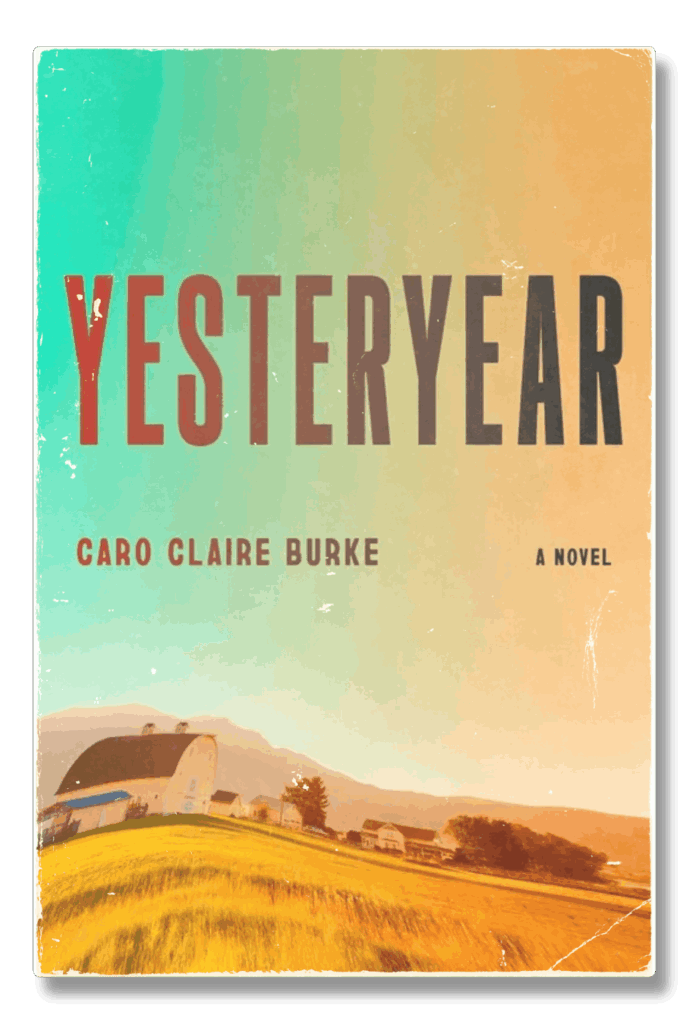

Yesteryear, Caro Claire Burke’s debut novel, is the picture of America presented to us through prairie dresses and buckets of raw milk. It’s homesteading, a small army of children, and a picturesque farm you’ve convinced yourself will Change Your Life. This aestheticized, traditional Americana lifestyle is the perfect backdrop for the tradwife influencer to flourish in, to cater to her audience of those aspiring to be her and those who want her and her kind off the internet forever. Natalie Heller Mills, the protagonist of Yesteryear, would rather die than refer to herself as a tradwife, but she’s more than happy to reap the benefits and profits that title affords her.
Every couple of months, the literary scene goes absolutely feral over an upcoming release, like frothing at the mouth waiting for the book to come out. Yesteryear officially hit bookstores on April 7, but I feel like I was hearing about it for at least half a year. Before its release, Yesteryear was the subject of an intense bidding war, with Alfred A. Knopf ultimately acquiring Burke’s manuscript in a seven-figure deal. Shortly after, Amazon MGM purchased film rights, with Anne Hathaway attached to the project as both star and producer. As someone who cares maybe too much about whether books live up to their hype, I needed to get my hands on a copy ASAP, and the publisher was kind enough to send an advance copy my way.
What initially caught my eye about this book was the premise; Natalie, our tradwife influencer, is the quintessential fantasy for traditional America. One day, she wakes up, and instead of her normal routine of baking a new sourdough loaf and passing her children off to the nannies, she’s in her house, but it’s 1855. The children aren’t her children, and her husband, Caleb, is a rough and harsh version of the man she married. I’ve lost track of how many times I’ve read (or wrote) an essay or a tweet criticizing the tradwife influencer phenomenon; criticism that essentially boils down to how these are women who are viewed in some circles as the pinnacle of womanhood, but their vision of womanhood is antiquated and rooted in patriarchal ideals.
Yesteryear takes that criticism and puts a face and a name to it, Natalie is a hypocrite to everything she stands for, she’s meant to be the vision of domesticity and traditional femininity, but in her life, career, and relationship, she takes on a more dominant and masculine role, even telling us, the reader, that she would have been the perfect husband with her drive and passion contrasting her husband’s more nurturing personality. She’s forced back into a time when the version of femininity she performs for millions of followers was the norm. In her new reality, she’s not baking bread in front of a tripod and a ringlight, she’s washing clothes until her fingers are raw and losing all power over her previously docile husband.
Yesteryear is a story that feels uncannily real. Or at least part of it does. Natalie Heller Mills is a massively successful tradwife influencer married to Caleb, a billionaire politician’s son turned farmer. They’re homesteading on their massive farm with 5 children (another on the way!), and it appears that they’re doing everything – raising and homeschooling children, tending to the animals and crops, and making all of their food from scratch, all while Natalie is creating content for her immensely popular social media page. If you’re like me and have stumbled down a tradwife rabbit hole, you might be asking yourself, “isn’t that just Ballerina Farm?” or “doesn’t Nara Smith do that from scratch stuff too?” and you’re not wrong. I’ve seen some online discussion about how Burke is essentially writing this novel to vilify Natalie and inflict punishment on her as a way to metaphorically punish the Ballerina Farms and Nara Smiths of the world.
Putting it bluntly, Natalie sucks. We’re in her thoughts for the entire book, from when she’s recounting her days at Harvard and mentally slut shaming the women in her hall, to when she’s describing her husband’s general laziness and the coldness she feels towards her children. This characterization is what makes the novel so gripping. Burke has often described Natalie as an “antihero,” and mentioned on her podcast, Diabolical Lies, how male characters that fit into this archetype are rugged heroes – they’re committing violence and leading with cruelty. They represent the harshness of America, but are idolized and viewed as the blueprint for manliness. Natalie possesses similar traits and is by no means a saint (although she would love to be one), but the reaction to her characterization and the jump to “Natalie’s entire character exists so Burke can bash tradwives” diminishes the poignant picture this novel paints about what womanhood in America looks like. Using a tradwife as a weapon to execute this point, someone whose entire existence and livelihood is rooted in her role as a woman, is an incredibly strong storytelling tool.
One of the most interesting elements of Yesteryear is how performance versus reality is explored. Natalie, being an influencer, so much of her life is curated. Producer Shannon plans her content and works to include scenes of her children gazing reverently up at her. Her followers would never know that she has nannies behind the scenes, essentially raising her children for her. The Online Natalie persona is a softened, more palatable version of her, nothing like the narcissistic woman we follow throughout the novel. In an era of #MomTok, Yesteryear serves as a reminder that as glossy as the images look on our screens, what lies beneath is often much murkier.
Talking about this book without spoiling the ending is a perilous quest, but I’ve accepted that burden, and I do have to pat myself on the back for getting this far without a peep. Honestly, I’m doing this for you because going into this and trying to figure out what’s happening was such a fun experience for me. I stayed up far too late with this book in my hand and the image of Anne Hathaway in a pioneer costume rattling around in my brain. As expected with a novel so intently commenting on the Society We Live In, there’s obviously something deeper at play. What I will say here, and as neutrally as possible, is that the ending of this book, and the story at large, felt very realistic to me. I was reminded of headlines I’ve read and the public’s reaction to unlikable and controversial women. I don’t think it’s perfect, but it speaks to many of the cracks we see in American society, and is one of the best reading experiences I’ve had in a while.
I hope that if you read this book, you’ll find me and tell me your thoughts on the ending, because if you’ve read all of this, it shouldn’t be shocking that literally no one’s surprised I have Many Thoughts and Lots To Say. What can I say? Like Natalie, I’m a woman with a strong opinion.